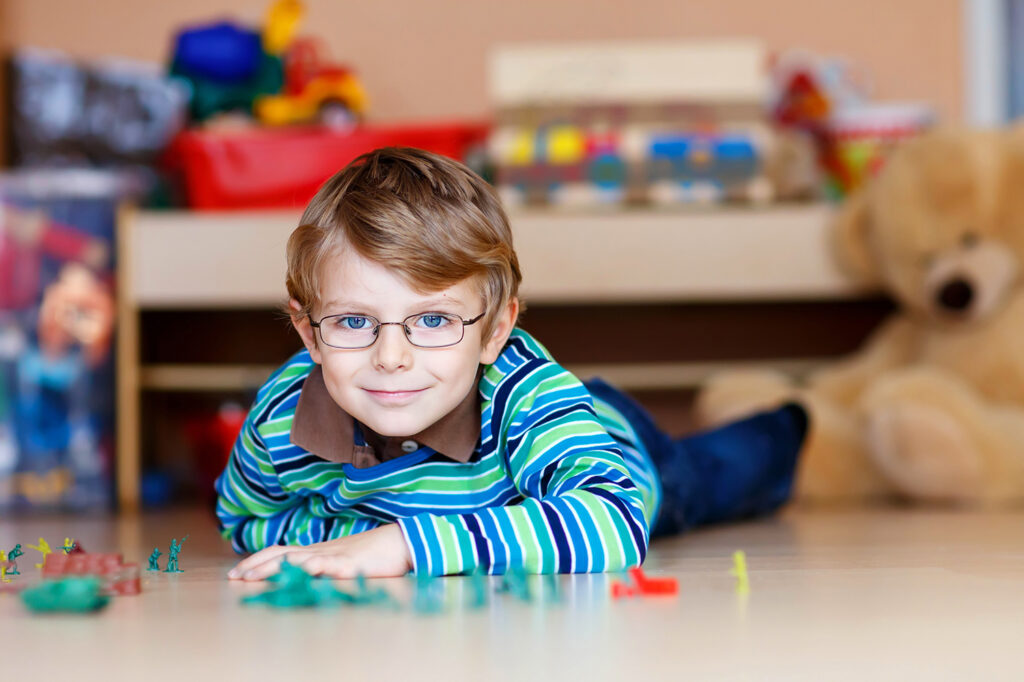
At Kennedy Vision Health Center, we’re passionate about providing clear vision for all our patients, including the little ones! We’ll carefully work with your child to make them comfortable as we check their eyes, create a personalized plan to stay on top of their myopia, and help them understand and care for their new eyewear!
Myopia Management

What is myopia?
Nearsightedness, or myopia, is a vision condition in which people can see close objects clearly, but objects farther away appear blurred. People with myopia can have difficulty clearly seeing a movie or TV screen or the whiteboard in school. Generally, myopia first occurs in school-age children. Just like feet getting bigger and children getting taller, the nearsighted eye tends to get longer over time. Because the eye continues to grow during childhood, this causes the eye to become longer and thus the need for stronger and stronger eyeglass prescriptions. Childhood myopia rates are increasing, with 1 in 3 now affected. Studies are showing that myopia is showing up at a much earlier age and progressing more rapidly.
What causes myopia?
Researchers are not sure exactly what causes myopia, but it is understood genetics play an important role. Studies have shown that if a child has a parent who is nearsighted, the child is 2x more likely to develop myopia than if neither of the child’s parents were nearsighted. If the child has two nearsighted parents, the child is over 5x more likely to develop myopia. Environment also seems to play a role in the development of nearsightedness; researchers believe reduced outdoor time and increased screen time on devices are part of the problem.
What are the risks of myopia?
There has been a steady rise in the presence of myopia in children, thought to be caused by an increase in screen time on computers, phones, and televisions during school and play. Myopia, if left untreated, can lead to your child needing stronger, more frequent updates to their vision prescription and put them at risk for developing eye conditions later in life, such as glaucoma.
What is myopia management?
Myopia Management is the nonsurgical treatment to improve your child’s vision now and slow down or stop the progressive loss of far vision.
Why try to control myopia growth?
Myopia treatments have been shown to reduce a person’s myopia by up to 60 percent, which could reduce the dependence for wearing glasses or contact lenses. Myopia has also been associated with common vision-threatening conditions like cataracts, open angle glaucoma, and retinal detachments. The risk of developing these conditions depends on the severity of the myopia; therefore, reducing a person’s myopia will reduce his or her chances of developing one of these vision-threatening diseases.
How long do I need to be treated?
Myopia Management is NOT a “one time treatment and then we’re done” but should be considered as an ongoing treatment until the eye stops growing and the vision stops changing, usually by your early 20’s. Myopia Management is NOT merely about your child not having to wear glasses during the day, but about trying to prevent their eyeballs from growing to the point where they are at much higher future risk for developing serious eye diseases. We promise to be as committed to your child’s success as you are, so we will remind you when it is time for your child’s yearly eye examinations, myopia status evaluations, and lens replacements.
Does your child show signs of myopia?
Does your child blink frequently, squint to see clearly, or have blurry vision, eye strain, and headaches? They could have myopia, but don’t worry — we’re here to help!
Schedule An Appointment
What Are My Myopia Treatment Options?
There are three ways to potentially slow the progression of myopia: corneal reshaping, special soft daily contact lenses and/or atropine eye drops. As explained above, each treatment has its special place, specific to every child. Not all patients are good candidates for each treatment. Our doctors will discuss the best treatment for your child.
- Ortho-Keratology/Paragon CRT (Hard Contact Lens)
- MiSight® Daily Soft Contact Lenses
- Stellest Myopia Control Glasses
- MiSight® + Stellest Lenses Combo
- Low Concentration Atropine Eye Drops
- Atropine + Stellest Lens Combo
Managing Myopia with Ortho-K Lenses/Paragon CRT
Corneal reshaping contact lenses are put in right before bedtime and are removed in the morning, similar to a retainer. These lenses gently and comfortably change the shape of the cornea so that your child can see clearly all day long without glasses or contact lenses, which is a wonderful option for activities like swimming or outdoor sports where wind and dust are a problem. Parents also appreciate this treatment option due to the lenses being worn only in the home, in a more controlled environment. This treatment option has been shown to reduce myopia progression on average by 50%.
MiSight® Daily Soft Contact Lenses
These specialty contact lenses are designed to be worn daily, to be put on in the morning and discarded every night. They are designed specifically to give the best vision for distance and near while slowing down the myopia progression. This treatment is an ideal option for children who are active or for those who dislike wearing glasses. Because they are single use lenses, they’re very comfortable all day long and significantly decrease the chances for any eye infection. These lenses have been shown to reduce myopia progression on average by 50%.
Stellest Myopia Control Glasses
These specialty glasses are FDA approved to slow the progression of Myopia, and are designed to be worn daily to replace your child’s everyday glasses. They are designed specifically to give the best vision for distance and near while slowing down myopia progression. This easy treatment is an ideal option for children who are not able to wear contact lenses and have difficulty with eyedrops. These glasses have been shown to reduce myopia progression on average by over 70%.
MiSight® + Stellest Lenses Combo
Specialty daily contact lenses as well as the specialty glasses. This program comes with one set of frames and a year’s supply of contact lenses.
Low Concentration Atropine Eye Drops
Special Low Concentration (0.01% – 0.05%) Atropine drops are applied nightly. Your child would still wear glasses or contact lenses during the day. This treatment modality is an excellent choice for families who have concerns over their child’s readiness for contact lenses and is often used for younger children. It has been shown to slow myopia progression by about 60%. Drops are shipped directly to you from the compounding pharmacy.
Atropine + Stellest Lens Combo
Special Low Concentration (0.01% – 0.05%) Atropine drops are applied nightly, as well as specialty FDA approved glasses. This program comes with a 12-month supply of Atropine drops shipped directly to you each month as well as 2 pair of lenses and two frames.
Are Myopia treatments safe?
We use FDA approved products, including contact lenses and prescription eye drops. Like all medical procedures, there are risks that our doctors will discuss with you during the consultation, but these are minimized by ensuring the right treatment for your child and consistent follow ups.
If at any time during the program your child experiences eye pain, discomfort, and/or redness, your child should remove the lenses immediately/discontinue drops and you should contact our practice to speak with your doctor (or if the office is closed, contact our after hours phone number at 763-269-2067.
Contact Lenses:
Children (ages 8-12 years) and teens (ages 13-17 years), both of which are age groups that are commonly fitted with contact lenses, are at an equally low risk for developing contact-lens related problems. Children and teens are able to wear their contact lenses for a similar amount of time each day. In addition, both groups feel that contact lenses improved their social acceptance, appearance, ability to play sports and overall satisfaction with their vision correction.
Atropine:
Low dose atropine is considered to be safe for children. Low dose atropine has been shown to work without increasing pupil size or decreasing near vision dramatically compared to the side effects of full-strength Atropine (1%). Children prescribed this treatment option will also be prescribed Transition Lenses (glasses that change from clear to dark when outdoors) to help with any potential light sensitivity.
Why choose Kennedy Vision Health Center for your child’s myopia management needs?
Kennedy Vision Health Center has remained on the cutting edge of eye care since we began serving our community. We follow the latest advancements in diagnostics and myopia management solutions and embrace proven innovations to give our patients the best possible results. When it comes to myopia management, our caring optometrists, optometric technicians, and optical specialists are well versed in Ortho-K and MiSight® 1 day lenses, and will help preserve your child’s vision and slow the progression of their myopia.